Wednesday, August 9, 2017

Color Theory: Complimentary Color Schemes

Source

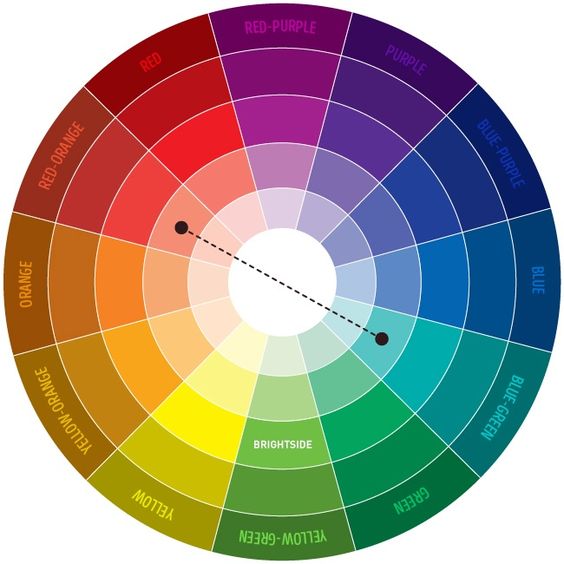
Most of us are familiar with the color wheel from elementary school art classes. While learning our colors is elementary enough, the study and implementation of color theory is not. It plays a huge role in design practice. A good designer understands how colors affect and play off of one another, even how they affect our mental state, and utilizes that when practicing design.


Complimentary colors, when used together in color schemes, are especially pleasing to the eye. Complimentary colors are the combination of any 2 colors opposite each other on the color wheel. The most commonly known combinations are with the primary colors: Red - green, blue - orange, and yellow - purple. These colors are the strongest contrast to one another and so when used together they really vibrate against one another, as well as, create a feeling of balance.

When using color combinations in an interior space, its great to accent with complimentary colors. Also there are natural elements that you can pull in that resemble colors from the color wheel, which are great for using as these accents. For example, using copper (orange) with blue, using gold (yellow) with purple, and using plants (green) with red. Having a hard time envisioning this?! These interior spaces with complimentary color schemes are sure to please the eye. After all, how are eyes see and perceive color is a science!

Blue - Orange

Source

Source

Source

Source

Source

Source

Source

Purple - Yellow

Source

Source

Source

Source

Source

Source

Red - Green

Source

Source

Source

Source

Source

Source

Source

Monday, August 7, 2017

Trend Alert: Copper Cosmetics

Something about copper keeps it synonymous with "cozy." Maybe it's the colors, those earthy shades of brown and orange. Maybe it's the way the metal catches and scatters light. Whatever the case may be, adding a touch of copper to your home can bring warmth and comfort in a way that no other material accomplishes.


In terms of adaptability, copper is hard to beat. It can be finished in metallic, matte or gloss and paired with complimentary woods, stones and glasses to create modern-urban, vintage, industrial and eclectic spaces. Contrast is key. Placed next to white and grey fixtures, copper can add that final detail you might need to finish a room. 


If there's one room copper shines best in, it's the kitchen. Matching copper fixtures used to contrast dark, solid colors popular in kitchen areas is  a sure-fire way to add flair and character to a room where steel, brass or marble might go unnoticed. For the most eye-catching copper design possible, go with a shade of blue; because copper is a warm orange and blue is orange's complimentary color. The two look amazing together and copper's natural varnish makes it turquoise as time goes on.


Copper is also a popular choice for free-standing bath tubs. If you're looking for a material to use for both your tub and your plumbing hardware, look no further. 


Friday, July 21, 2017

Industry Ed with Richard: Kitchen & Bath Guideline Series - Tubs

In this post we will discuss the NKBA Kitchen and Bathroom Planning Guidelines, by first stating the guidelines and then pointing out their importance and giving insight on solutions and practices based on my industry experience. Find out more about NKBA here.

This is a follow-up on last month's blog entry. Last month, we showed you showers. This week, we're tackling tubs!

TUBS


NKBA Guidelines

  • The wall area above a tub should be covered in a waterproof material to a height of not less than 72" above the finished floor.
  • The tub controls should be accessible from both inside and outside the tub and be located between the rim of the bathtub and 33" above the floor. 
    • Tub controls must be operable with one hand and not require tight grasping.
    • Controls must be on an end wall of the bathtub, between the rim and grab bar and between the open side of the bathtub and the midpoint of the width of the tub. 
  • A permanent tub seat should be at least 15" deep and positioned at the head end of the bathtub. The top of the seat should be between 17" and 19" above the bathroom floor.

My Experience

  • The trend now is freestanding tubs. These are tubs that don't require a wall or deck to attach to. They are great for fitting full-sized tubs in smaller spaces.
    • The most sought-after is the "clawfoot" design, but there are limitless styles that work with any aesthetic.
    • An important choice you have to make is where to mount the plumbing.
      • Many freestanding tubs have a rim thick enough to mount plumbing directly to the tub.
      • Other tubs require you mount plumbing to the floor.
      • Most people mount plumbing at the back end of the tub, but this requires you bend to switch it on or off. 
      • In my experience, the best place to mount plumbing is on either side of the tub.
  • Another way to save space is to use a shower/tub combination. For that, you need an alcove tub.
    • Alcove tubs are designed to catch water and fit between three walls, so they are perfect for the shower/tub combo.
  • Deck tubs are also popular. These are tubs that mount to a surrounding deck, giving you that "sunken" look.
    • A common mistake with deck tubs is placing the tub too far back in the deck. Keep in mind, the farther back the tub is, the farther you have to stretch to get in or out.
  • There's this misconception people have that installing a grab bar in a shower or tub makes a bathroom look like a hospital bathroom. I couldn't disagree more. Grab bars are easy to install, convenient and do not detract from the appearance of a bathroom. Furthermore, having a grab bar is infinitely safer than not having one.
    • Plus, most plumbing lines can give you grab bars that match the look of your towel racks and other hardware.
  •  There are a lot of options for waterproofing a shower or tub area. 
  • Regarding floors, the industry is moving away from traditional rubber slip guards and toward engineered flooring. 
  • Likewise, we are seeing less whirlpool and jet tubs.
    • As opposed to soaker tubs, whirlpools and jets store water when switched off and can easily be contaminated.
Here are a few tubs to give you inspiration: